Discover Yourself
Awareness → Consciousness → Coherence
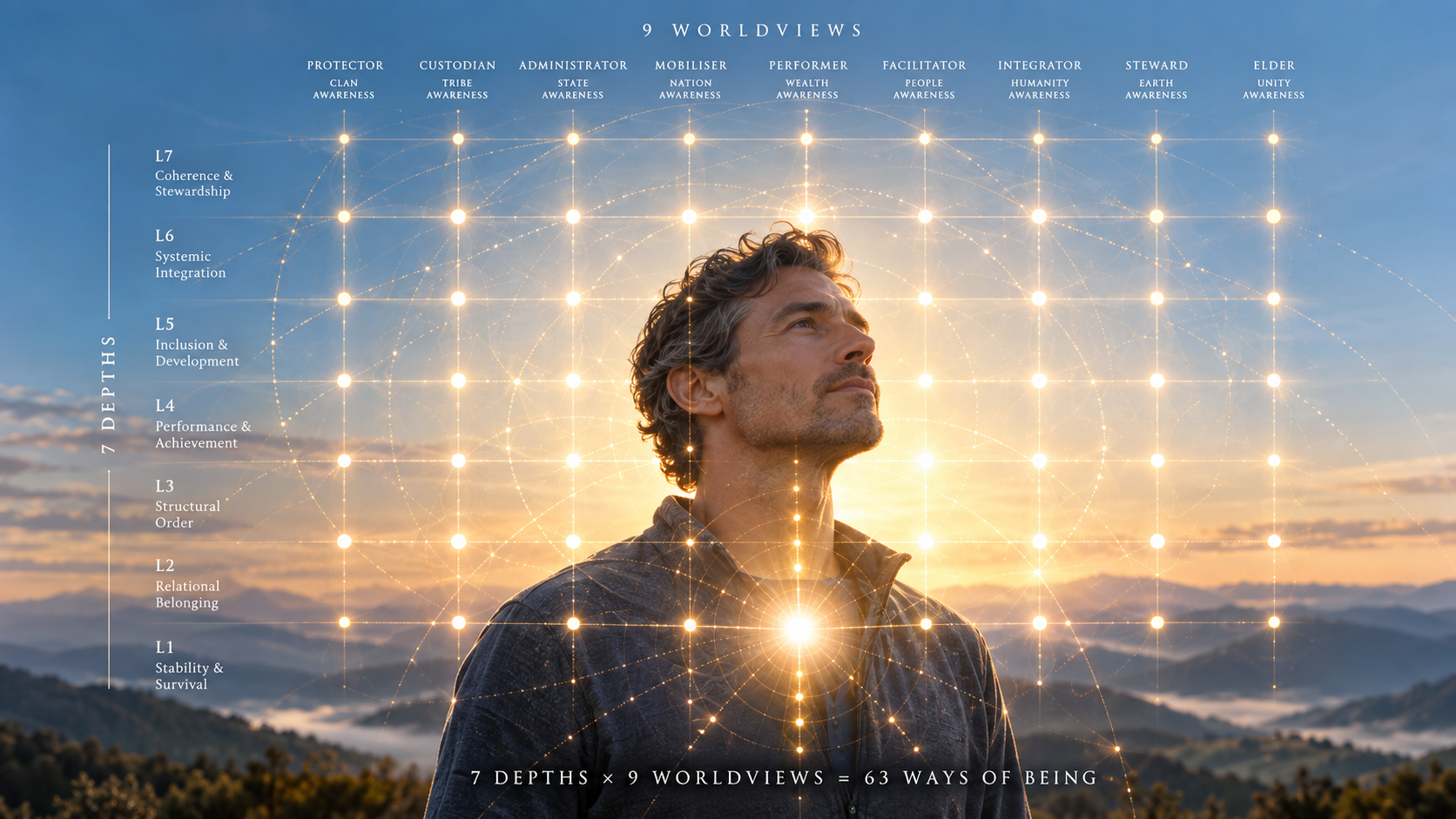
Every human being has Awareness. Awareness meets reality directly. Consciousness interprets reality. And Consciousness develops along two dimensions — how widely it perceives, and how deeply it understands. We do not see the world as it is. We see what Consciousness interprets for us.
Seven Levels
How deeply Consciousness understands. Seven levels of psychological development. How free we are to perceive and respond to life from love rather than fear.
Nine Worldviews
How widely Consciousness perceives. Nine worldviews. How wide a circle of identity and concern shapes what we take to be relevant.
7 Depths × 9 Worldviews = 63 Ways of Being
Our natural, and most coherent way of being emerges from the intersection of the depth and breadth of our consciousness.
The Coherence Matrix
Whereas depth describes how much a person can hold, Worldview describes how they see. A Worldview is the lens through which we interpret reality and decide what matters, and there are nine, ranging from Clan Awareness, which sees through the eyes of family and kin, to Unity Awareness, which sees the whole as one. Each Worldview has an archetype, the Protector, the Custodian, the Administrator, the Mobiliser, the Performer, the Facilitator, the Integrator, the Steward, and the Elder, which names the character through which that way of seeing acts in the world.
Explore the book: The Architecture of Human Consciousness ↓Explore the Book
Part I
The opening chapters lay out the two-part claim the whole book will spend the rest of its length demonstrating: that human Consciousness develops along two independent dimensions rather than one. This part introduces the search for a hidden order beneath human behaviour, establishes Consciousness itself as a developmental process rather than a fixed trait, and locates the architecture that underlies personal, organisational and societal systems alike. It then separates the two dimensions that later parts will each take in turn — depth, how far interior development has progressed, and breadth, how wide a circle of identity and concern a person’s Worldview extends to. Everything that follows depends on this separation being genuinely understood before the map is unfolded.
Part II
This part maps the seven levels through which Consciousness deepens, from the survival-oriented foundations of the earliest level to the Unity Consciousness of the most advanced. Each chapter takes one level in turn and asks the same set of questions of it: what does the world look like from here, what capacities become available at this depth, and — critically — does this level tend to express itself through Shadow or through Soul. That last question is the spine of the whole section. The same developmental level can show up as fear-driven contraction or as its integrated, generous counterpart, and Part II is where the book establishes that depth alone does not determine which.
Part III
Where Part II asks how deeply a person sees, Part III asks how widely. It maps the nine Worldviews through which awareness expands outward — from the tight boundary of clan and kinship, through nation, organisation and humanity, to Earth and Unity — and examines, Worldview by Worldview, how each one interprets reality, what form of leadership it produces, what it contributes to human development, and what its own characteristic limitations look like when it operates from Shadow rather than Soul. The governing idea is that Worldview and level are independent: two people can share a level of psychological development and still see the world through entirely different Worldviews, with correspondingly different notions of who counts and what matters.
Part IV
The final part brings the two dimensions back together. Having examined depth and breadth separately, it now crosses all seven levels against all nine Worldviews to produce the sixty-three configurations of the Coherence Matrix — the full landscape of ways a human being can be in the world. This is where the book’s opening claim is finally made concrete: that a person’s Way of Being emerges from the interaction of their stage of development and their Worldview, not from either alone. Part IV is less a new argument than the payoff of the first three parts — the point at which depth and breadth, having been deliberately kept apart for the length of the book, are shown to have been describing a single architecture all along.
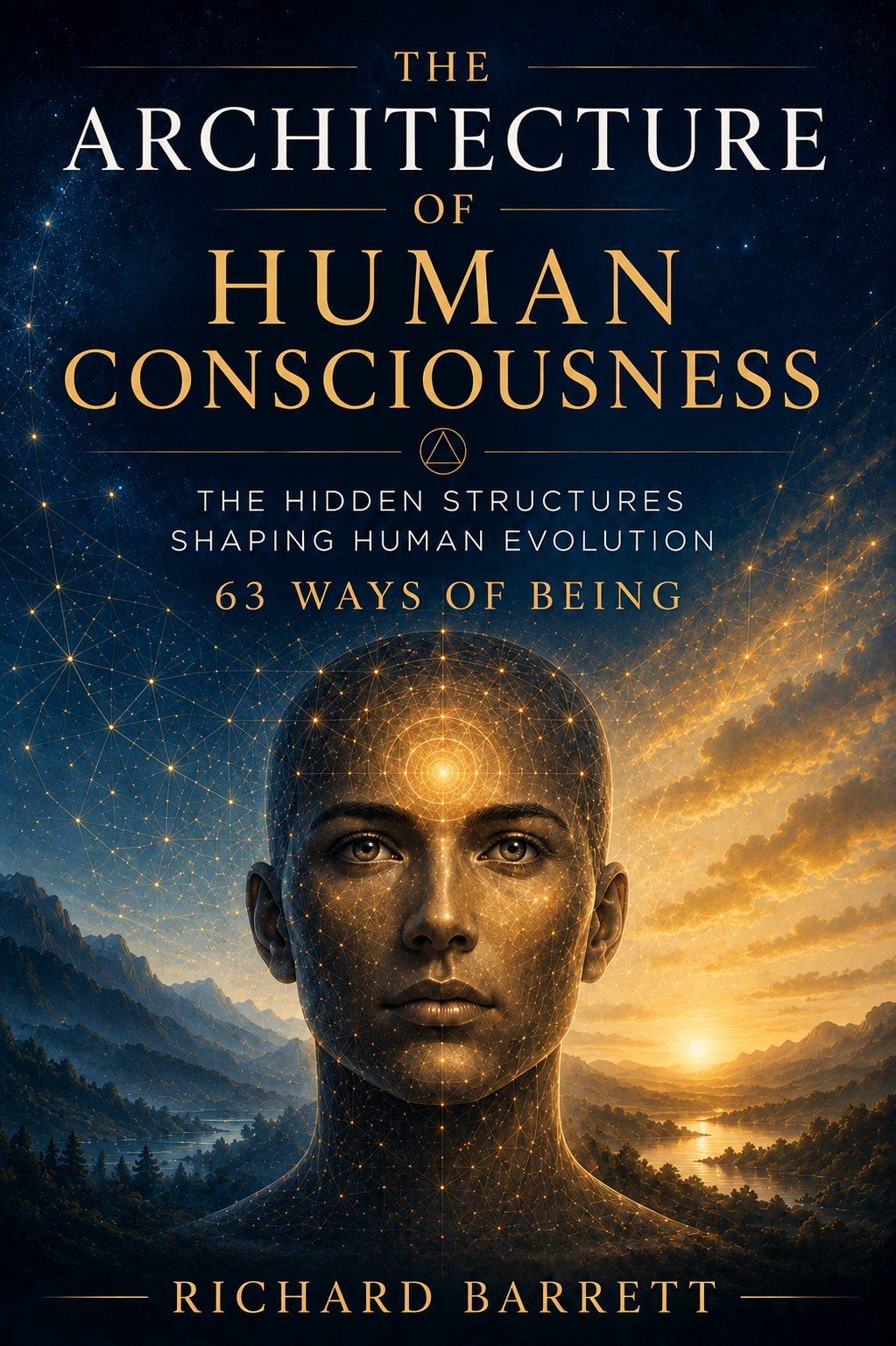
Something invisible shapes every decision you make, every assumption you hold and every conflict you cannot resolve.It is not your values. Not your beliefs. Not your intelligence or experience. It is the structure of Consciousness itself — the hidden architecture through which reality is perceived, meaning is constructed and human behaviour emerges.The Architecture of Human Consciousness maps that structure for the first time in a single unified framework. Drawing on four decades of research across psychology, developmental theory and the observation of human systems at every scale, Richard Barrett reveals that Consciousness develops along two interlocking dimensions. The first is depth — the seven stages through which awareness matures from survival and belonging toward integration, stewardship and unity. The second is breadth — the nine Worldviews through which identity expands from the bonds of clan and kinship to the recognition of a single living reality.
The Mirror
The structure of consciousness through which reality is perceived and given meaning, usually experienced not as a lens but simply as the way things are.
The specific, innate gifts of the Organising Mind, available when it is sufficiently integrated and no longer operating from fear.
The defensive distortion of the Organising Mind that emerges when it is overextended, threatened, or asked to handle more complexity than its current capacity allows.
Shadow
The relatively fixed shadow formed for the purpose of protection in the first stages of life, from the wounds, defences and identifications of childhood, which dominates and constrains further growth until it is substantially acknowledged and integrated.
Shadow
The potential shadow associated with the configuration of Consciousness which is currently active — a moving target that changes form as a person develops, rather than a fixed residue of the past.
Interaction
Early Shadow and Developmental Shadow are not independent. An unresolved Early Shadow can intensify whatever Developmental Shadow is currently active, giving it more force than the present configuration alone would produce. And acute pressure on a Developmental Shadow can, in turn, reach back and reactivate the earlier pattern it originally grew out of.
Development
Development occurs when the Shadow is integrated — the same movement through which the qualities of Soul are revealed.
This is not two processes occurring side by side, one of removal and one of discovery. It is a single movement seen from two directions. As the defensive distortions of the Organising Mind are recognised and no longer left to operate unseen, what was previously constrained by them becomes available. Soul is not something released afterward — it is what the Organising Mind looks like as Shadow stops distorting it.
The Free Assessment
The Mirror Report helps you identify your most coherent Way of Being, your Developmental Opportunities, and what is holding you back.
01
This is where your Worldview and your depth of Consciousness meet — the configuration that emerges when how widely you see and how deeply you see are read together. It names the way you most consistently perceive, decide and act when you are operating at your best: not an aspiration, but a description of a pattern already present in how you engage with the world.
02
These are the innate qualities of your Organising Mind, available to the degree it is integrated and not operating from fear. They are not qualities you must acquire. They are already yours, waiting on the capacity that unlocks them — and they show themselves most clearly whenever Shadow is not distorting what is naturally there.
03
This is the predictable distortion of the Way of Being you have just identified — what happens to your particular strengths when they are overextended, threatened, or asked to carry more than their current capacity allows. Shadow is not a flaw to be ashamed of. It is information: a precise signal of where growth is currently being asked for.
04
Development is the integration of Shadow — the same movement through which the qualities of Soul are revealed. As the distortions of your Organising Mind are recognised and no longer left to operate unseen, what was previously constrained by them becomes available. This section names where that movement is most available to you now: not a list of faults to correct, but the specific ground on which your next growth is already waiting.