The Coherence Principle
Many researchers study why things fail. The deeper question is why systems succeed in remaining whole.
The Framework
The Coherence Principle argues that everything which persists — a cell, a person, an organisation, a nation — has solved the same underlying problem: it must hold its own parts together while remaining answerable to a reality it does not control.
I
Allows the parts to do different things
II
Allows the parts to function as a whole
III
Allows the whole to be corrected when it encounters realities it does not control.
A Critical Distinction
Internal coherence
Relational coherence
A system can possess strong internal coherence while progressively losing relational coherence — and the loss may remain invisible until reality finally imposes consequences the system can no longer exclude.
Restoring Coherence begins with creating the conditions in which information from beyond a system’s existing account can genuinely enter. Incoherence must then become visible, and visibility must deepen into self-recognition: the people with the greatest influence over the system have to recognise not only what is happening, but their own part in producing it, because information without recognition and ownership does not restore Coherence on its own.
Loss of differentiation leads to uniformity
Loss of integration leads to fragmentation
Loss of openness to correction leads to closure
Personal Coherence
Organisational Coherence
Societal Coherence
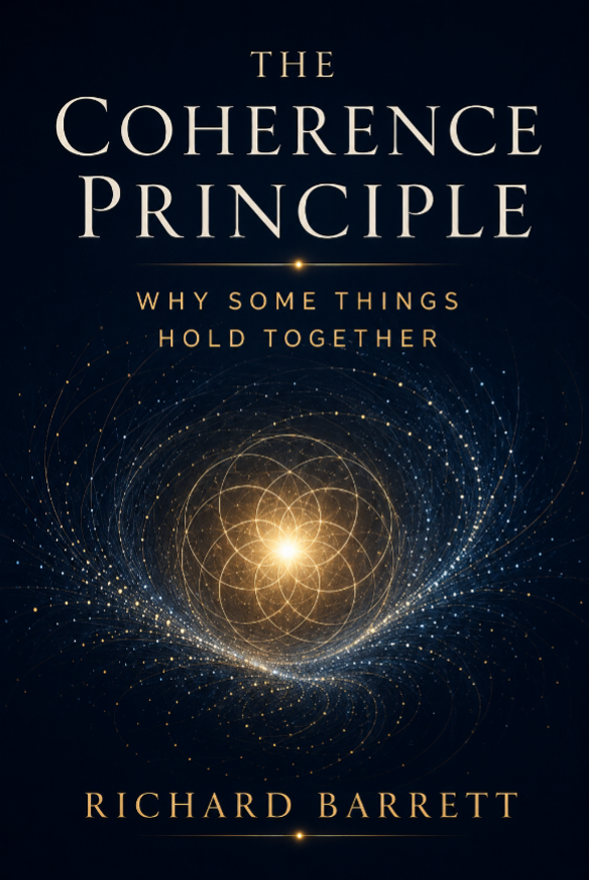
Drawing on four decades of work inside organisations, and on evidence ranging from Boeing and the UK Post Office to Nedbank’s decade-long entropy record and Iceland’s post-crisis reckoning, Richard Barrett traces what happens when that balance is lost — not only as fragmentation, the failure everyone recognises, but as Closed Coherence, the far more dangerous failure that can look like strength right up until it isn’t.
The Coherence Principle moves from the person to the organisation to society, showing that restoration follows the same sequence at every scale: a system must first reopen to information it has been protecting itself against, allow its own incoherence to become visible, and let that visibility deepen into genuine self-recognition among those with the greatest power to change it. Values, Barrett argues, were never the whole story: they are one mechanism through which the deeper principle of Coherence expresses itself. The Coherence Principle is the book that finally explains why.