Living Coherence
How work can create genuine contribution and lead to a coherent, fulfilling life.
About the Book
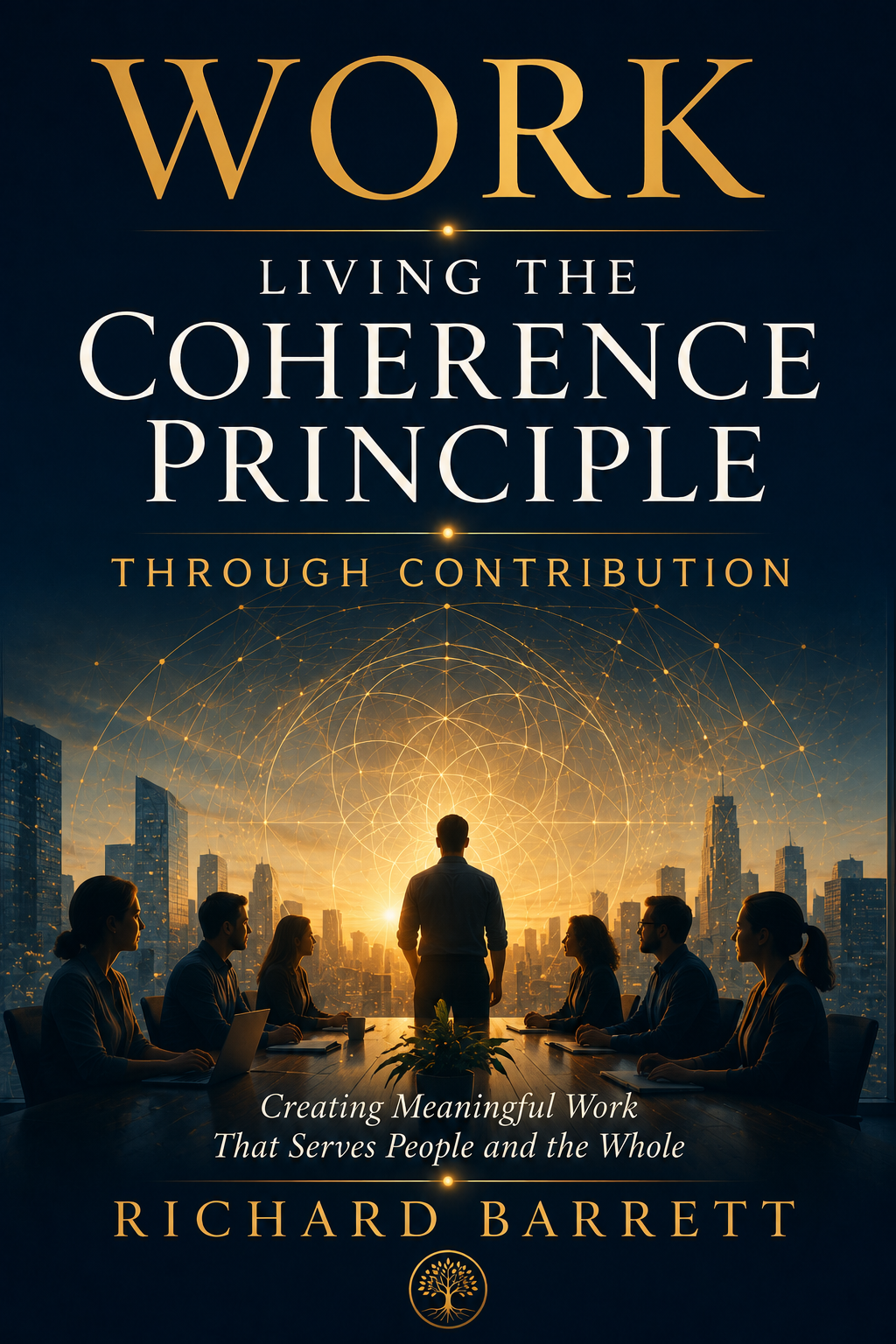
Living the Coherence Principle through Contribution asks what makes work meaningful — not the job title, not the size of the role, but how fully that work is lived as genuine contribution. Drawing on the same three conditions that hold any coherent life together — differentiation, integration and openness to correction — the book explores what changes when work becomes an expression of who a person is rather than a role performed to specification, and what happens, in a career and in a life, when it never does.
Inside the Book
There are six primary topics in the work book. Click a topic to read its description.
01
Most people arrive at work having already decided, usually without noticing they have decided anything, how much of themselves they are willing to bring into the building. A version gets left at the door — the uncertain part, the tender part, sometimes the most honestly capable part — and a more polished, more defensible version takes its place for the day. This is differentiation quietly failing before the workday has even begun: not because the person lacks depth or values, but because they have concluded, somewhere along the way, that only a narrower slice of themselves is safe to bring.
Bringing yourself to work does not mean abandoning professionalism or treating a workplace as a confessional. It means allowing your actual values, actual judgment and actual concerns to be present in how you do the job, rather than performing a role that has been emptied of them for the sake of appearing easier to manage. A person who brings themselves to work can still disagree, still say the harder thing, still bring a perspective nobody asked for — and it is precisely this presence, rather than its absence, that tends to make their contribution worth having in the first place.
02
Pressure is where the difference between a performed self and an integrated one becomes impossible to hide. In calm conditions, almost anyone can appear coherent — values, behaviour and self-presentation can be made to line up convincingly enough. It is only when a deadline tightens, a decision goes wrong, or a colleague says something uncomfortably true that the actual architecture underneath becomes visible, because pressure removes the luxury of careful curation.
What meets you under pressure at work is rarely a stranger. It is usually an old, familiar pattern — the same defensive reflex, the same withdrawal or the same over-control that shows up in every part of a person’s life, simply wearing its work clothes. Recognising this is the beginning of something useful, because a pattern that repeats itself in a predictable form is a pattern that can eventually be met deliberately, rather than being lived through as though it were new and unaccountable each time it appears.
03
No job is actually done alone, however solitary the task may feel at the desk. Working with others is where a person’s capacity for integration is tested most directly and most often — whether the differences between colleagues can be held as genuine, useful distinctness, or whether they collapse into rivalry, resentment or an enforced, brittle agreement that nobody actually believes. A team that has lost this capacity does not usually look chaotic from the outside. It often looks unusually smooth, because disagreement has simply stopped being voiced.
The harder and more valuable version of working with others asks for something less comfortable than smoothness: the willingness to let a colleague’s different read on a problem actually change your own, and the willingness to be corrected by people who do not share your position, your title or your certainty. This is openness to correction operating at the scale of a working relationship rather than only within a single mind, and it is usually the difference between a team that merely coexists and one that genuinely thinks together.
04
Work is frequently treated as something a person survives on the way to a life that happens elsewhere — evenings, weekends, retirement. This framing quietly forecloses one of the more reliable developmental grounds available to most adults, because work reliably supplies exactly the conditions growth actually requires: real consequences, real feedback, real people who are not obliged to be kind about your blind spots.
Growing through work does not require a dramatic career change or a sudden promotion. It requires treating an ordinary difficult meeting, an uncomfortable piece of feedback, or a project that did not go as planned as material rather than as an inconvenience to be got past as quickly as possible. A person who is willing to ask what a specific failure at work is actually showing them about their own patterns will, over years, develop in ways that a person who only ever asks how to avoid the next failure generally does not.
05
Meaning at work is commonly searched for in the wrong place — in the job title, the mission statement, the size or prestige of the role — as though meaning were a property some jobs simply possess and others lack. This search rarely succeeds, because meaning is not a feature of the role. It is a consequence of how fully a person is present within it, bringing their actual judgment, actual care and actual values to bear on what they do, rather than performing competently at a distance from all three.
This is why two people in identical roles can report entirely different relationships to their own work — one finding it hollow, the other finding it genuinely purposeful — without either of them being wrong about their own experience. The difference is rarely the job. It is almost always the degree of Coherence the person has managed to bring into it: how much of themselves is actually present, how well that presence is integrated with the demands of the role, and how open they remain to what the work itself might still be trying to teach them.
06
Achievement and contribution are often treated as the same thing, measured by the same metrics — the promotion secured, the target hit, the project delivered on time. They are not the same thing, and the difference matters more than it first appears. Achievement is fundamentally self-referential: it asks whether I met the standard, hit the number, secured the outcome I was aiming for. Contribution asks a different question entirely: what did this actually add to something beyond myself, and would its absence have been felt by anyone other than me.
The movement from achievement to contribution is not a renunciation of ambition or competence; it is what ambition and competence look like once they have matured past needing to prove something about the person exercising them. A leader operating from achievement asks how a decision reflects on them. The same leader operating from contribution asks what the decision actually does for the people and the system it touches — and it is this shift, more than any change in skill or title, that tends to mark the point at which someone’s work becomes, in the fullest sense, their contribution rather than merely their record.
Get the Book
The full book is available on Richard’s author website.