Living Coherence
How to hold life together in a meaningful way when you no longer have to work.
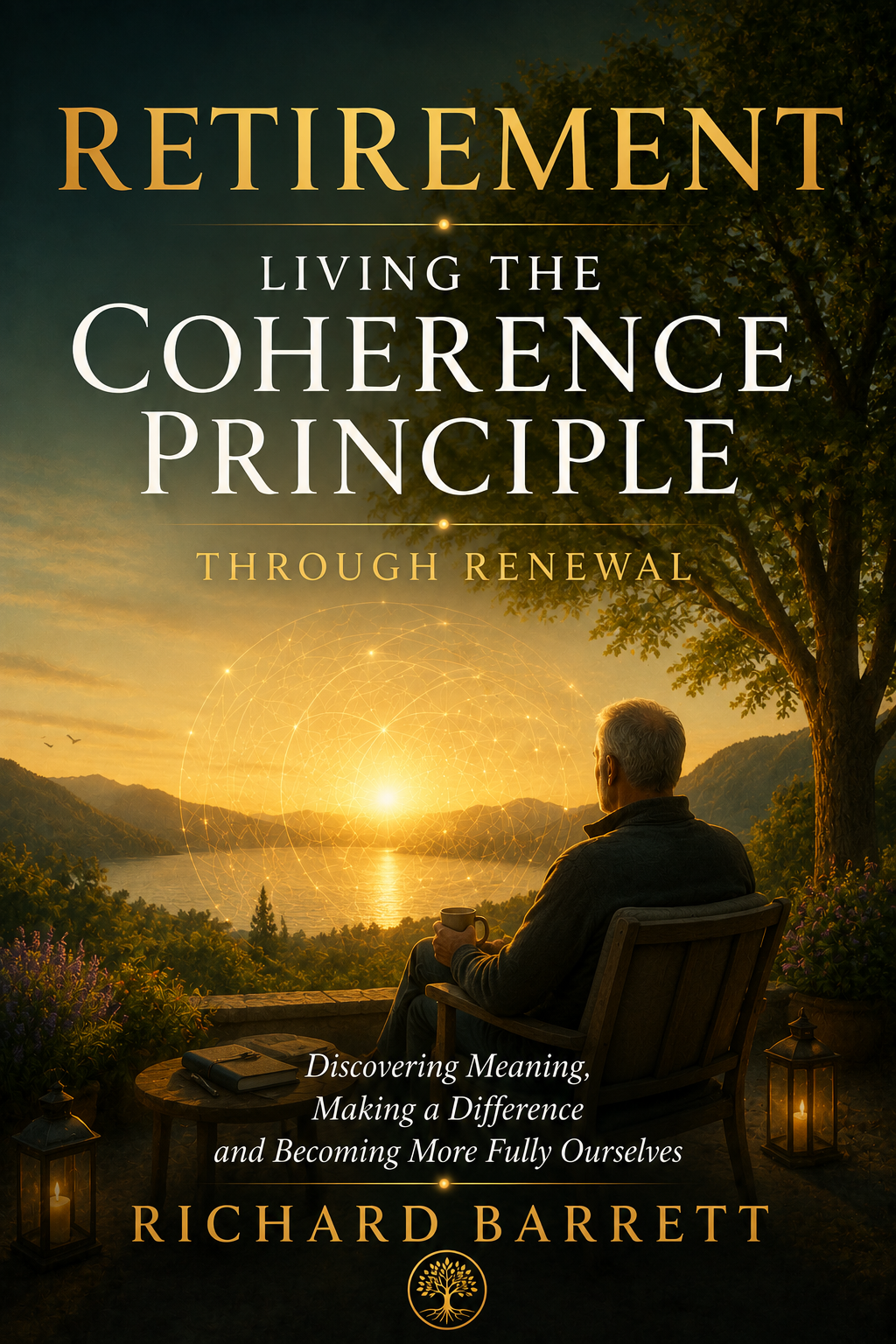
About the Book
Retirement removes, often abruptly, the structure that has organised a person’s differentiation, integration and daily correction for decades — the job title that answered the question of who they were, the colleagues who supplied continual feedback whether solicited or not, the schedule that gave their days a shape they had long since stopped having to think about. The book’s central claim is that what remains once all that scaffolding is gone is the real measure of how coherent a person actually was underneath the role, rather than because of it. For some, retirement reveals a self that was always more than the job. For others, it reveals how much of what looked like identity was, in fact, borrowed integration — coherence supplied by the structure rather than built by the person, and now suddenly unsupported.
Approached well, retirement is not a slow withdrawal from a meaningful life but a distinct developmental stage in its own right, with its own form of contribution to make, its own relationships to deepen or repair, and its own ongoing requirement to stay open to correction rather than settling into a fixed account of who one has already become. Renewal, in this sense, is not a return to an earlier version of the self that working life interrupted. It is the harder and more interesting task of building a genuinely new configuration of purpose, relationship and contribution, using the same three conditions of Coherence that carried the person through every earlier stage of their life.
Inside the Book
There are six primary topics in the retirement book. Click a topic to read its description.
01
For most people, leaving working life behind is experienced less as a single clean departure and more as an extended, uneven unwinding — a sudden absence of the meetings, deadlines and daily structure that had quietly organised so much of the self for decades. The book treats this period with more seriousness than the usual language of “adjustment” suggests, because what is actually being lost is not merely a routine but a significant portion of a person’s differentiation and integration, both of which had been resting, often unnoticed, on the scaffolding of a working role. The disorientation many retirees describe in the early months is not a character weakness or an inability to relax. It is an accurate, if uncomfortable, signal that a load-bearing structure has been removed.
The task at this stage is not to rush toward a replacement activity simply to fill the resulting quiet, though this is often the first instinct. It is to sit long enough in the absence to discover which parts of one’s former coherence were genuinely one’s own — values, relationships, a sense of purpose that will travel forward — and which parts belonged to the role itself and were never going to survive its ending regardless of how the retirement was managed. Leaving working life behind well begins with this honest sorting, before any new rhythm is built to replace what has gone.
02
Decades of working life leave most people fluent in a professional identity and considerably less practised at any other. Rediscovering yourself, in the book’s treatment, is not a search for a self that was lost so much as an active reconstruction of one that may never have been given much room to develop alongside the demands of a career — interests set aside decades earlier, relationships deprioritised for the sake of the job, even values quietly subordinated to whatever the role required for as long as the role lasted.
This rediscovery asks for real differentiation: the willingness to find out who is actually present once the professional title is no longer available to answer the question by default. It is often slower and less comfortable than people expect, precisely because a role that has been worn for thirty or forty years does not come off easily, and a person may need to sit with real uncertainty about who they now are before anything resembling a rediscovered self begins to take clearer shape.
03
A working life comes with a rhythm built entirely by other people — start times, deadlines, quarters, calendars set by an employer rather than chosen by the person living inside them. Retirement removes that externally imposed structure all at once, and the unstructured freedom that follows, while often anticipated eagerly, can just as easily produce a kind of formlessness that erodes wellbeing rather than enhancing it. The book is candid that unlimited free time is not, by itself, a gift; it is raw material that still has to be shaped into something workable.
Creating a new rhythm of life is this shaping — building structure that is chosen rather than imposed, and specific enough to organise the days without simply recreating the rigidity of a working schedule that was rightly left behind. This is integration doing new work: finding a way for rest, contribution, relationship and reflection to function together as a coherent whole, rather than existing as disconnected activities filling otherwise empty time.
04
Working life structures a great many relationships by default — the colleagues seen daily without any particular effort required to see them, the professional network sustained largely through shared proximity rather than deliberate cultivation. When that structure disappears, many of those relationships quietly disappear with it, and the resulting narrowing of social contact is one of the more underestimated risks of an otherwise well-planned retirement.
The book argues that relationships in this new season require the same three conditions of Coherence, now applied more deliberately than working life ever demanded of them: genuine differentiation, so relationships are chosen for who a person actually is rather than maintained out of habit or proximity; real integration, so a smaller circle of relationships can still function as an adequate, coherent support rather than a thin and scattered one; and ongoing openness to correction, so long-standing relationships — with a spouse, with adult children, with old friends — can keep adapting to two people who are each still changing, well into a stage of life many wrongly assume has stopped requiring that kind of adjustment.
05
Much of working life measures a person by achievement — targets met, positions attained, results delivered against some external standard. Retirement removes the scoreboard that achievement was measured against, and for people whose sense of worth had become closely tied to that scoreboard, this removal can feel less like relief than like a genuine identity crisis. The book treats this moment as an opportunity rather than only a loss: an opening to move, deliberately, from a life organised around achievement toward one organised around contribution.
Contribution, unlike achievement, does not require an employer, a title or a competitive context to exist. It asks a different, quieter question: what does this stage of life allow a person to offer — to family, to community, to some cause or piece of knowledge accumulated over a lifetime — regardless of whether anyone is measuring it. Making this shift well is often what determines whether retirement is experienced as diminishment or as a genuinely new and worthwhile chapter, built on a different foundation than the one working life provided.
06
Beneath the practical questions of schedule, relationship and activity, the book locates a deeper invitation that retirement makes more available than perhaps any earlier stage of life: the chance to become more fully coherent, with less external structure obscuring the task and less time remaining in which to keep postponing it. Freed from the daily demands that working life imposed, a person has, often for the first time since childhood, the space to ask directly what they actually value, who they actually are apart from any role, and what they still owe to their own ongoing development.
This is not a comfortable invitation, and the book does not pretend otherwise. It asks a person to keep differentiating, keep integrating and keep remaining open to correction precisely when it would be easiest to assume that kind of work belongs to an earlier stage of life now safely behind them. But for those willing to accept it, the deeper invitation of retirement is that Coherence, rather than diminishing with the loss of a working role, has one more genuine stage still available to be built — arguably the one with the least distraction and the clearest view of what actually matters.
Get the Book
The full book is available on Richard’s author website.