Living Coherence
How to apply the Coherence Principle during every stage of a child’s development.
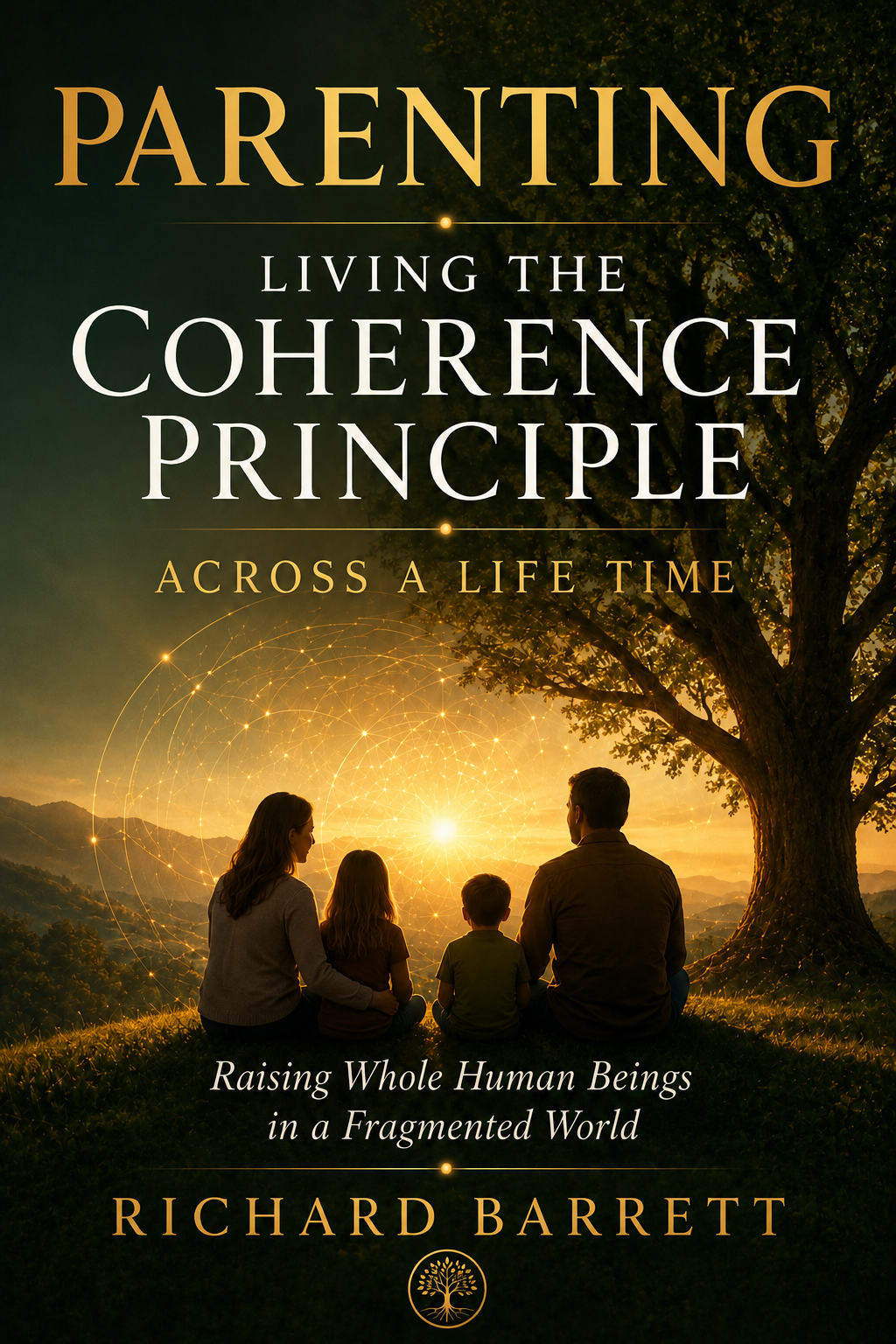
About the Book
Parenting is Coherence practised across a moving target, because the child a parent is raising is a different person every few years, and the task changes accordingly even though its purpose never does. What a coherent parent is actually building, from infancy through adulthood, is a person who will one day be able to hold their own differentiation, their own integration and their own openness to correction, without their parent in the room. This means the parent’s task is not to protect the child from every difficulty, but to remain coherent enough themselves — present, consistent, correctable — that the child has something stable to develop against at every stage.
Inside the Book
There are six primary topics in the parenting book. Click a topic to read its description.
01
Becoming a parent is rarely the single event a due date or an adoption day suggests; it is closer to an ongoing initiation, one that goes on revealing what it actually asks of a person for months and years after the moment itself. The book treats this becoming as a genuine developmental threshold in the parent’s own life, not merely a role added on top of an otherwise unchanged self. A person can prepare a nursery, read every book and still be caught off guard by how thoroughly a child’s arrival reorganises their own priorities, fears and sense of what actually matters.
Part of becoming a parent well is recognising that a great deal of what a new parent brings to the role — their own early experience of being parented, their own unexamined fears, their own unresolved Shadow — arrives in the room whether invited or not. A parent who has done some work on their own Coherence before a child arrives is not spared the difficulty of new parenthood, but they meet it with more of themselves already available, rather than discovering their own unresolved patterns for the first time in front of a newborn who depends entirely on them.
02
In the earliest years, a parent’s primary task is to hold — literally and psychologically — a level of stability, structure and safety that the child has no capacity to provide for themselves. This is Coherence loaned rather than taught: the parent’s own differentiation, integration and openness to correction functioning as a kind of external skeleton for a child who has not yet grown one of their own. A child who is held well in this sense does not experience the world as chaotic even when it genuinely is, because a steady adult presence is absorbing that chaos on their behalf.
As the child grows, holding gradually gives way to guiding, and this transition is one of the more difficult judgment calls parenting asks of a person, because guiding too little leaves a child without the structure they still need, while guiding too much prevents them from developing the very capacities guidance is meant to build toward. The book frames this as a continual, active recalibration rather than a single shift made once — a parent constantly reassessing how much scaffolding a particular child, at this particular stage, genuinely still needs, and how much is now quietly in the way.
03
Every parent meets moments that test the limits of their own patience, self-control and self-understanding — the defiance that arrives at the worst possible time, the failure to protect a child from a hurt that could not be foreseen, the days a parent’s own reaction to their child surprises and unsettles them. The book treats these moments not as failures to be managed away as quickly as possible, but as some of the most direct and honest information a parent will ever receive about their own unresolved Shadow, delivered by the one relationship in which it is hardest to look away from.
A parent who can meet a difficult moment with curiosity about what it is revealing in them, rather than only with an urgent need to end the discomfort it is causing, tends to grow through parenting rather than merely surviving it. This is not a demand for perfect composure — children do not require parents who never struggle, and a parent’s honest repair after a difficult moment often teaches more than an absence of difficulty ever could. What it asks for is a willingness to stay open to correction even inside the hardest moments, rather than closing around a defensive account of what just happened.
04
At some point, usually well before a parent feels ready for it, a child begins to differentiate in earnest — developing tastes, convictions and a sense of self that do not simply mirror the parent’s own. This is not a rupture to be resisted but the entire point of the process finally becoming visible, and the book is direct about how difficult this can be for a parent whose own sense of purpose has become entangled with shaping the child in a particular image. Letting a child become themselves means tolerating a version of them that may diverge, sometimes sharply, from what the parent imagined or hoped for.
This is integration’s counterpart at the level of the whole family: the parent’s task shifts from producing agreement to sustaining relationship across genuine difference, allowing the child’s emerging distinctness to remain part of a coherent family rather than treating it as a threat to be corrected back into alignment. A parent who cannot tolerate this differentiation does not produce a more coherent child. They usually produce one who either suppresses their real self to preserve the relationship, or who leaves the relationship in order to have a real self at all.
05
Release is the stage parenting is ultimately building toward, and it is also the stage many parents find hardest to trust, because it asks them to stop actively holding a coherence they have spent two decades supplying and to trust that enough of it has actually transferred. The book is candid that this trust is sometimes only partially justified — a young adult may stumble, badly, in exactly the areas a parent worked hardest to shore up — but argues that continuing to hold on past the point of usefulness does more damage than a premature or imperfect release, because it prevents the young adult from discovering capacities they will never test while a parent is still doing the work for them.
What follows release is not the end of the parent-child relationship but its transformation into something structurally different: a relationship between two adults, each capable of their own differentiation, integration and openness to correction, relating to each other by choice rather than by the earlier necessity of dependency. Parents who manage this transition well tend to describe it less as losing a child than as finally meeting the adult that decades of holding and guiding were always working toward.
06
The book’s closing claim is that parenting was never a one-directional project, however much it can feel that way in the exhausted middle of it. A parent shapes a child, unmistakably, but a child also reshapes a parent — confronting them with their own patience or its absence, their own patterns inherited from their own parents, their own capacity to keep growing at a stage of life many people assume growth has mostly finished. Raising a child turns out to be one of the more reliable developmental accelerants available to an adult, precisely because a child has no obligation to be diplomatic about what they reveal.
Becoming together, in this sense, describes a family in which the direction of development runs both ways across the whole span of the relationship — a parent who is still growing alongside a child who is growing, each one’s Coherence quietly conditioning the other’s, right through to the point where the original roles of parent and child have loosened into something closer to two people who happened to grow up, in different ways, together.
Get the Book
The full book is available on Richard’s author website.